Quality controls
29 raw defects identified
Synthetic portfolio project — not paid production experience.
A bounded technical case showing how a reporting model can make defects, controls, reconciliation, and management review visible.
Built and validated a static synthetic reporting system with 14 imported tables, 27 DAX measures, six pages, 12/12 quality controls, and 7/7 reconciliations.
View résuméStatic technical evidence only. No live refresh, client, cloud, or production environment is implied.
The project supplies technical proof that confidential professional work cannot safely show: model structure, DAX measures, report-page design, quality controls, and independent reconciliation.
Deterministic synthetic inputs moved through a SQL star schema into committed measures and six static report pages. Independent tests and reconciliations verified the model rather than relying on the interface alone.
Seed deliberate defects so quality controls could be tested rather than merely described.
Validate source and model totals independently.
Keep the PBIX static and disclose the missing live-refresh layer.
Separate interface evidence, model diagrams, and validation evidence.
Document limitations as part of the technical result.
29 raw defects identified
Independent checks passed
Deterministic validation
Exact synthetic reconciliation
These crops are synthetic snapshots, not a live dashboard.
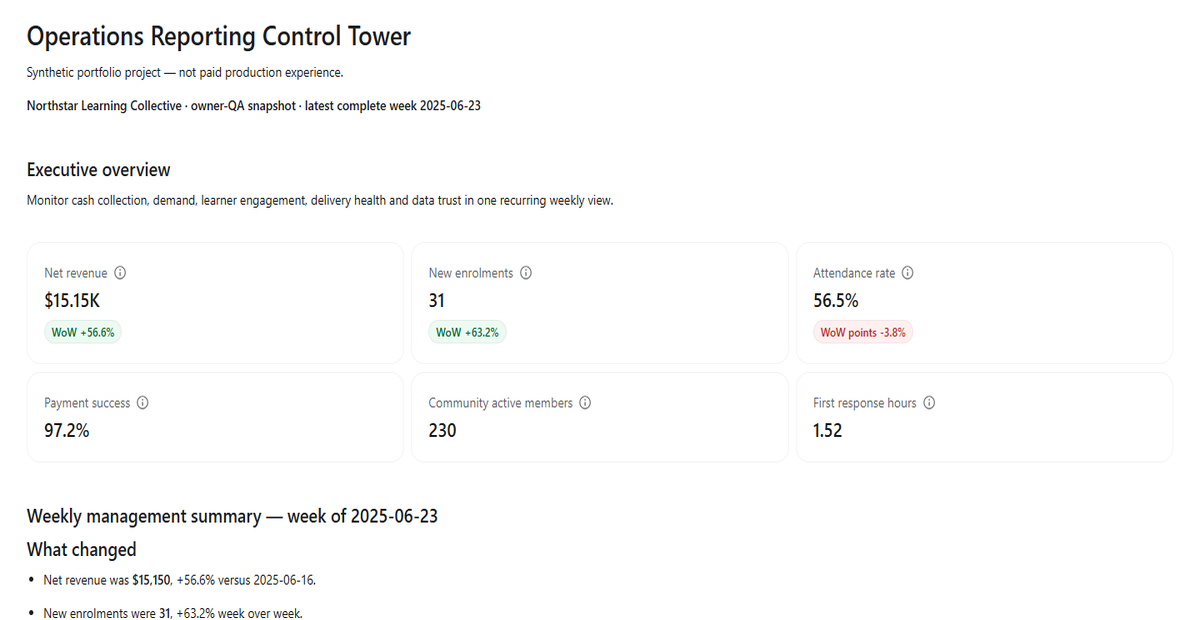
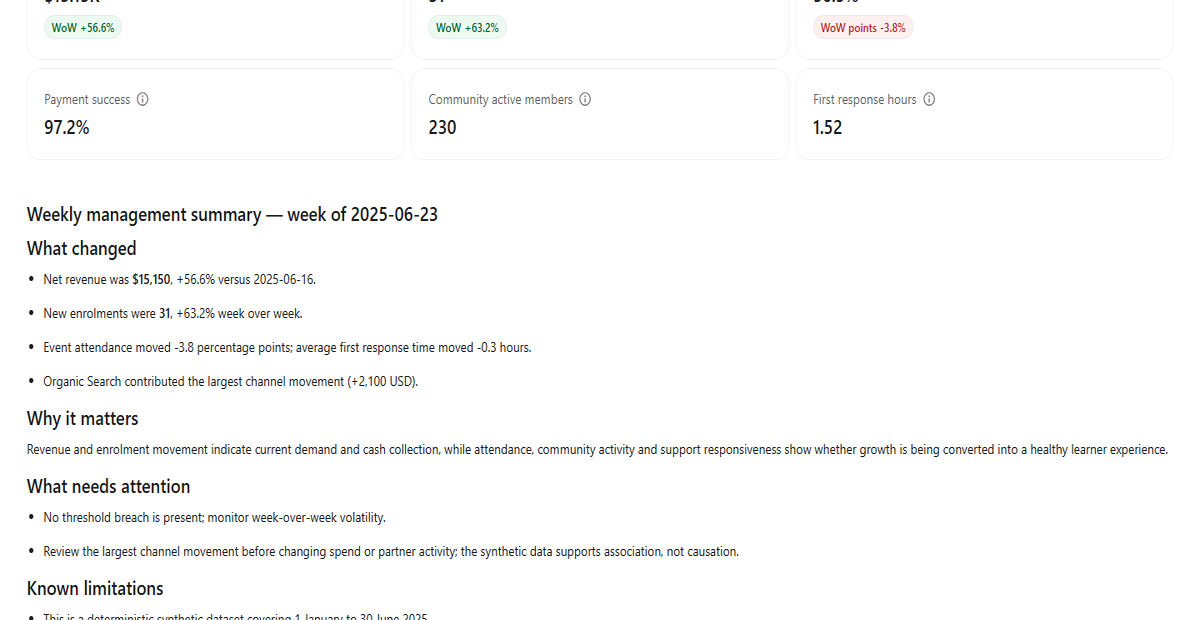
Power BI, DAX, SQL, star-schema modelling, testing, reconciliation, and documentation support the case. Seven independent checks passed, including an exact synthetic net-revenue reconciliation of $290,200.
The PBIX is a validated static snapshot with no Power Query or DataMashup live-refresh layer. It demonstrates a project model, not an enterprise architecture or operational service.
Synthetic portfolio project — not paid production experience. The data is synthetic, the PBIX is a validated static snapshot, and there is no live refresh, client deployment, or cloud or enterprise environment.
No client system, paid deployment, production cloud platform, enterprise warehouse, live refresh, or operational service is claimed.