Jan 21–Mar 4, 2026 · Professional work

Programme Operations System

A distributed analytics cohort needed one visible operating rhythm across time zones, teams, checkpoints, technical support, submissions, feedback, and future-round handoff.

One-line outcome

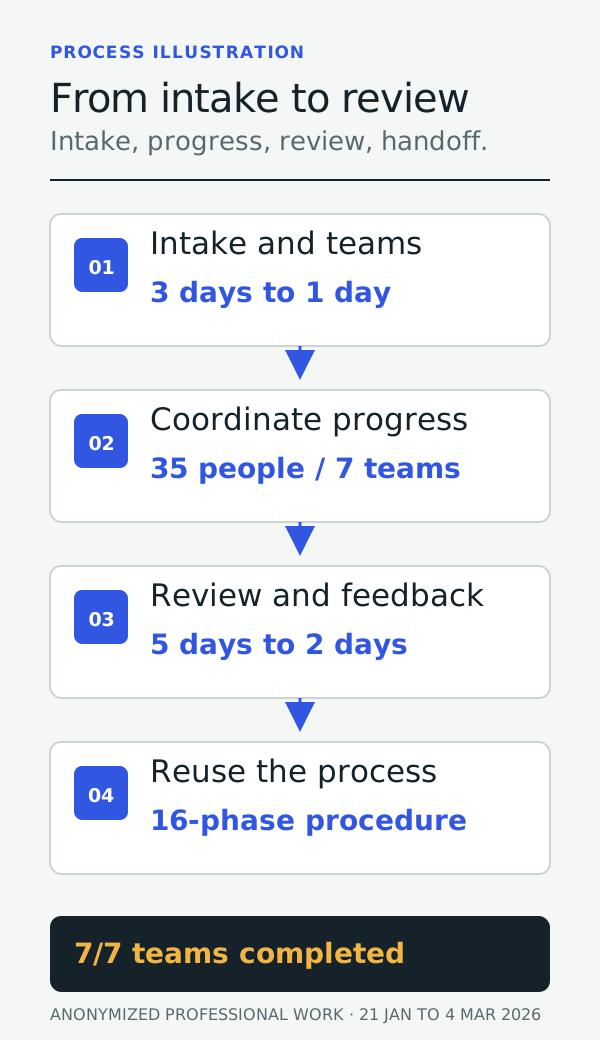
Coordinated 35 participants across seven teams and converted intake, check-ins, blocker handling, review, and handoff into a reusable 16-phase operating process.

View résumé
At a glance
Context
Anonymous distributed analytics cohort across multiple time zones
Role
Reporting & Operations Analyst
Scale
35 participants · seven teams
Scope
Reusable 16-phase operating process
V-301 / Teams · phases · handoff
Thirty-five participants across seven teams Thirty-five anonymous participants were coordinated across seven teams through one shared operating rhythm; no individual data is shown. T1T2T3T4T5T6T7 35 PARTICIPANTS · 7 TEAMS · ONE OPERATING RHYTHM
Seven anonymous team lanes converge on a shared checkpoint and handoff rhythm.
01 / Context and ownership

Seven teams needed one visible operating rhythm.

Operating challenge

Participants worked across time zones and needed consistent expectations, team-lead communication, visible checkpoints, blocker escalation, and a clear submission and review path. The operating model also needed to be reusable by future operators.

What Isaac owned

  • Participant intake and time-zone or availability coordination.
  • Team formation, team-lead communication, and kickoff coordination.
  • Progress visibility, midpoint check-ins, blocker follow-up, and submission tracking.
  • Review coordination, feedback, wrap-up, and the reusable 16-phase procedure.
02 / Process and decisions

Routine updates and blocker escalation followed different paths.

The operating rhythm moved from intake through team formation, checkpoints, blocker follow-up, submission, review, feedback, wrap-up, and a documented handoff another operator could follow.

01

Use availability and time-zone rules to form teams faster.

02

Establish team-lead communication and midpoint update expectations.

03

Separate routine check-ins from blocker escalation.

04

Standardize submission, review, and feedback steps.

05

Turn the operating sequence into a 16-phase procedure for future rounds.

03 / Approved outcomes

Checkpoints brought blockers and turnaround into view.

35

Participants

One bounded cohort

7/7

Midpoint updates

Every team reported

3d → 1d

Intake and formation

Clearer operating rules

5d → 2d

Review and feedback

A shorter review cycle

V-306 / Sixteen-phase operating processSixteen steps grouped into four readable operating chapters.
01–04IntakeAvailability · formation · lead alignment · kickoff
05–08DeliveryProgress · updates · support · blocker ownership
09–12ReviewSubmission · review · feedback · follow-through
13–16HandoffWrap-up · record · lessons · next-round setup
V-303 / V-305 · Cycle changesClearer rules shortened two operating loops.
Intake + formation3d → 1d
Review + feedback5d → 2d
Technical detail where useful

The 16-phase process leaves a repeatable handoff.

Structured tracking, documented SOPs, time-zone and availability coordination, and targeted technical support were the method. All seven teams supplied midpoint updates; unresolved blockers reduced by an approved 25–35%, and on-time submission improved by 10–15 percentage points.

This was programme coordination, not formal line management. The reusable procedure reduced future-round setup by an estimated one to two days.

Evidence disclosure

What is safe to show

Professional programme-operations work for an anonymized distributed analytics cohort. People and team details are withheld; the case uses approved aggregates and original process diagrams.

What remains outside the claim

What is deliberately absent

Participant and team identifiers, private messages, channel names, workspace links, screenshots, submissions, individual feedback, and individual performance are omitted.